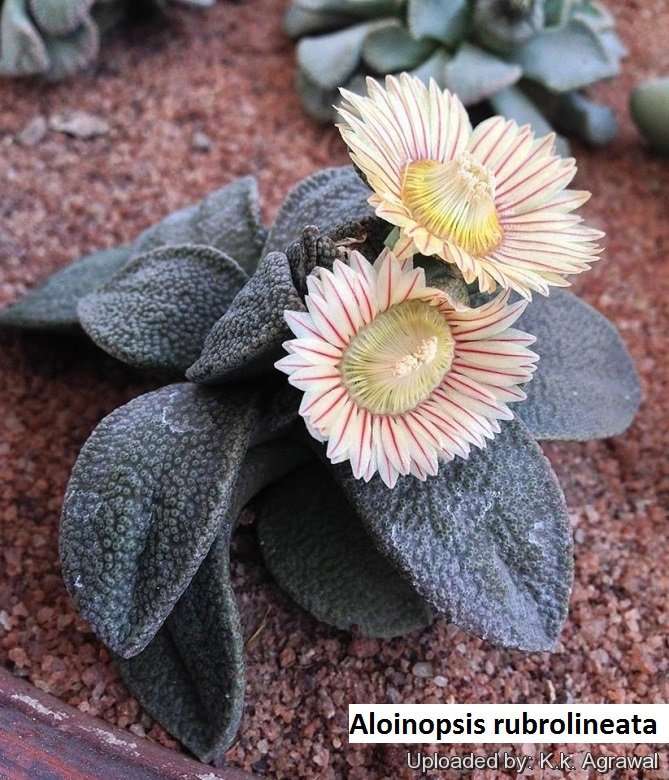
Common names Striped vygie Synonyms Mesembryanthemum rubrolieatum, Nananthus rubrolineatus, Aloinopsis dyeri Origin and Habitat Native to South Africa USDA Hardiness Zone Zones: 8a to 10b Maximum size Height: 20-30cm/ Spread: Mat-forming, caudex grows up to 7.5 cm in diameter Care Tips Expected germination rate 50% Growth Rate Slow Maintenance Easy Sun Exposure Full to partial sun Watering Medium Soil type and pH Well-draining, sandy, loamy chalky, acid to neutral pH 5 to 7 With its intense purple coloration, warty surface and striking, big, daisy-like flowers, Aloinopsis rubrolineata is quite popular among succulent collectors. This is a dwarf, multi-branching, mat-forming succulent native to South Africa where it grows in various altitude ranges in arid climate areas in the crevices of rocks. The bumps on the leaf surface are quite prickly and so crowded that they cover the entire surface and give it a whitish tinge. These bumps along with the hard, leathery leaf surface are believed to have the function of saving water and preventing excessive water loss through the epidermis. Being native to an extremely arid and hot region, Aloinopsis rubrolineata apply several strategies to overcome drought. For example, Its roots are tuberous and leaves are thick for storing water. The plant grows several rosettes of opposite-paired, tongue-shaped leaves. Each pair grows from the central fissure between the two leaves of the older ones. Leaves can vary in shape. For example, in one specimen it can be club-shaped, while in another they may be of the shape of a rabbit’s ears. Flowers grow in the winter. They are solitary, borne on numerous stalks that grow from the plant’s basal part. They look like daisies, creamy white in color with an orange line in the center of each petal. The basal part of petals is markedly orange. Petals are extremely thin and are numerous. The central part of the flower is a cluster of stamens and stigmas, the male and female reproductive organs of the flower. The genus name Aloinopsis means ‘similar to aloe’ as the plant looks similar to some dwarf aloe species. The name rubrolineata refers to the central red stripe on the flower petals. Aloinopsis rubrolineata is very easy to grow, especially if you live in warm climates with dry winters. It needs a lot of sunlight, but you should avoid direct sunlight during the hottest period of the day. Ideally it should get light in the morning and late afternoon. As long as it gets plenty of direct sun in this way, its purple tinge will be enhanced. Aloinopsis rubrolineata is a hardy plant that survives temperatures until -12-degree C if the soil is maintained completely dry. But when the temperature is below 0-degree C, it’s advisable to bring it indoors. Water every week in summer and every 2-3 weeks in other seasons. However, in winter water only when the soil is completely dry. Prolonged rains in the winter can damage the tubers of this plant, so, you should be watchful. Since it has a huge root system and also as it grows horizontally and soon covers the ground, Aloinopsis rubrolineata needs a big, deep pot if you want to grow it in a container. Aloinopsis rubrolineata is a robust plant and is hardly any pests or diseases can attack it. As such, mealybugs are the only pests attacking this plant. If it occurs, you should isolate the affected plant and apply a pesticide to remaining leaves after removing the damaged leaves. Aloinopsis rubrolineata can be propagated using seeds and cuttings. Seeds germinate in a few weeks. SHIPPING: Shipped out within 5 working days. Unregistered letter (NO TRACKING). For more about delivery times click here: HOW TO ORDER! SOWING INSTRUCTIONS: click HERE!